
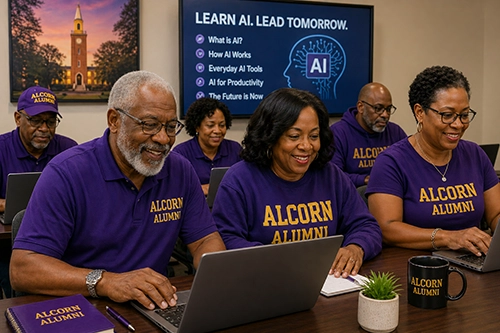
For generations, Alcorn State University has stood as a place where tradition, resilience, and innovation meet. Founded in 1871 as the nation’s first Black land-grant college, Alcorn has long prepared its students and alumni to lead in changing times. Today, that tradition continues in one of the most important shifts of the modern era: artificial intelligence.
Across the Alcorn family—from recent graduates entering the workforce to retirees exploring new interests—alumni are learning how artificial intelligence can improve the way they work, communicate, solve problems, and serve their communities. What once sounded like futuristic technology is now becoming practical, approachable, and increasingly useful for everyday life.
For Alcorn alumni between the ages of 20 and 90, the rise of artificial intelligence is not just a story about machines. It is a story about opportunity. It is about learning new skills, staying competitive, building businesses, preserving relevance, and continuing the Alcorn tradition of leadership in a changing world.
Why Artificial Intelligence Matters to Alcorn Alumni
Artificial intelligence is no longer reserved for engineers, coders, or Silicon Valley startups. It is now woven into everyday tools many alumni already use—search engines, smartphones, customer service platforms, healthcare systems, banking apps, and even email assistants.
In practical terms, artificial intelligence helps people work faster, think more strategically, and automate routine tasks. For younger alumni, that can mean writing stronger résumés, preparing for interviews, or improving workplace productivity. For mid-career professionals, it may mean streamlining business operations, analyzing data, or improving customer communication. For older alumni, it can mean learning a useful new skill, organizing information, or staying connected in a more digital world.
The value is not simply in understanding artificial intelligence as a trend. The real advantage comes from learning how to use it well.
That is where Alcorn’s legacy becomes especially important. Alcorn alumni have always adapted—through social change, economic shifts, and evolving industries. Artificial intelligence is simply the next chapter in that long tradition.
Alcorn Is Building an Artificial Intelligence Culture
Alcorn is not watching the AI movement from the sidelines. The university is actively helping shape it.
In recent years, Alcorn State University has expanded its investment in artificial intelligence education, workforce development, and innovation. In 2025, the university announced a collaboration with AWS Machine Learning University to help faculty integrate AI and machine learning into classroom instruction. That initiative brought new curriculum tools, faculty training, and stronger career pathways for students preparing for AI-driven industries.
That same momentum expanded through Mississippi’s AI Talent Accelerator Program, which awarded Alcorn $1.15 million to strengthen digital literacy and artificial intelligence training across underserved communities in southwest Mississippi. The effort was designed to equip learners with practical AI fundamentals and workforce-ready digital skills.
More recently, Alcorn made headlines as the first HBCU to fully operationalize artificial intelligence through a partnership tied to NVIDIA-powered infrastructure—another sign that the university is positioning itself as a serious player in the next generation of AI education.
For alumni, these developments send a clear message: Alcorn is not just teaching artificial intelligence. It is building an ecosystem around it.
What Artificial Intelligence Looks Like in Everyday Life
One of the biggest misconceptions about artificial intelligence is that it is only useful for highly technical careers. In reality, many of the most practical uses are simple, accessible, and immediately useful.
For alumni working in business, AI can draft emails, summarize reports, create marketing copy, and analyze customer trends.
For educators, it can help generate lesson ideas, organize materials, and simplify administrative tasks.
For entrepreneurs, it can assist with branding, social media, customer service, and business planning.
For healthcare professionals, it can support documentation, scheduling, and patient communication.
For retirees, it can help with writing, research, planning, and staying organized.
In practice, the most successful AI users are not always the most technical. They are often the people who ask better questions, understand their goals, and learn how to guide the tool effectively.
That makes artificial intelligence less about programming and more about problem-solving.
Why Alumni of Every Age Can Benefit
One of the most encouraging things about artificial intelligence is that there is no age limit on learning it.
A 24-year-old Alcorn graduate can use AI to improve job applications and build career momentum.
A 47-year-old professional can use it to increase productivity, sharpen presentations, and improve decision-making.
A 68-year-old entrepreneur can use it to support a side business, simplify operations, and reach new audiences.
An 82-year-old retiree can use it to write memoirs, organize family history, or explore lifelong learning in a new way.
That broad accessibility matters, especially in alumni communities that span generations. The value of artificial intelligence is not limited to one career stage. It grows differently depending on where a person is in life.
For younger alumni, AI can create speed and access.
For experienced alumni, it can create leverage and efficiency.
For older alumni, it can create convenience, creativity, and continued engagement.
That is what makes this moment so significant. Artificial intelligence is not replacing the wisdom of experience. It is making that experience more useful in new ways.
The Real Skill Is Knowing How to Think
The most important lesson in artificial intelligence is not technical. It is strategic.
People often assume AI mastery means learning software. In reality, the most valuable skill is learning how to think clearly, ask better questions, and interpret results wisely.
That means knowing how to:
- Ask precise questions
- Check facts and verify outputs
- Refine weak responses
- Spot bias or incomplete information
- Use judgment before using automation
These are not just digital skills. They are leadership skills.
And that is where Alcorn alumni already have an advantage.
Experience teaches discernment. Professional maturity teaches judgment. Community leadership teaches responsibility. Those qualities matter just as much in artificial intelligence as technical fluency.
In many ways, the strongest AI users will not be the loudest adopters. They will be the people who combine curiosity with wisdom.
Artificial Intelligence and the Future of the Alcorn Network
Artificial intelligence also creates something larger than individual convenience. It creates collective opportunity.
As more Alcorn alumni learn AI techniques, the benefits extend beyond personal productivity. They begin to strengthen the wider alumni network.
Professionals can mentor younger graduates more effectively.
Entrepreneurs can build smarter businesses.
Educators can share stronger tools.
Community leaders can improve outreach and communication.
Retired alumni can preserve institutional memory and life experience in new digital formats.
This is where artificial intelligence becomes more than a personal tool. It becomes a shared advantage.
That matters for any alumni network. It matters even more for one with Alcorn’s history, mission, and multigenerational reach.
Common Mistakes to Avoid When Learning AI
As useful as artificial intelligence can be, it works best when approached with balance.
The most common mistake is assuming AI is always right. It is not. It can be fast, helpful, and impressive—but it can also be incomplete, outdated, or wrong.
Another mistake is overcomplicating the learning process. Most alumni do not need to become engineers. They need to become confident users.
A third mistake is treating AI as a replacement for human judgment. It is not. It is a tool. The human still provides the wisdom.
The strongest approach is simple: stay curious, stay practical, and stay thoughtful.
Conclusion
Alcorn alumni have never been strangers to change. From one generation to the next, the Alcorn story has always been about adaptation, resilience, and leadership.
Artificial intelligence is simply the newest tool in that tradition.
For Alcorn alumni, learning AI techniques is not about chasing hype. It is about staying informed, staying useful, and staying ready. It is about using new tools with the same discipline, intelligence, and purpose that have always defined the Alcorn spirit.
And once again, Alcorn alumni are proving they know how to meet the moment.
Author Bio
Larry Hubbard writes about education, innovation, and community leadership with a focus on practical technology and lifelong learning. His work explores how emerging tools like artificial intelligence can create meaningful opportunities across generations.